


Today I have a little something different for you all. It is inspired by the convergence of my two worlds—medicine and woo.
I’m excited to announce that I was just level 1 Reiki certified!
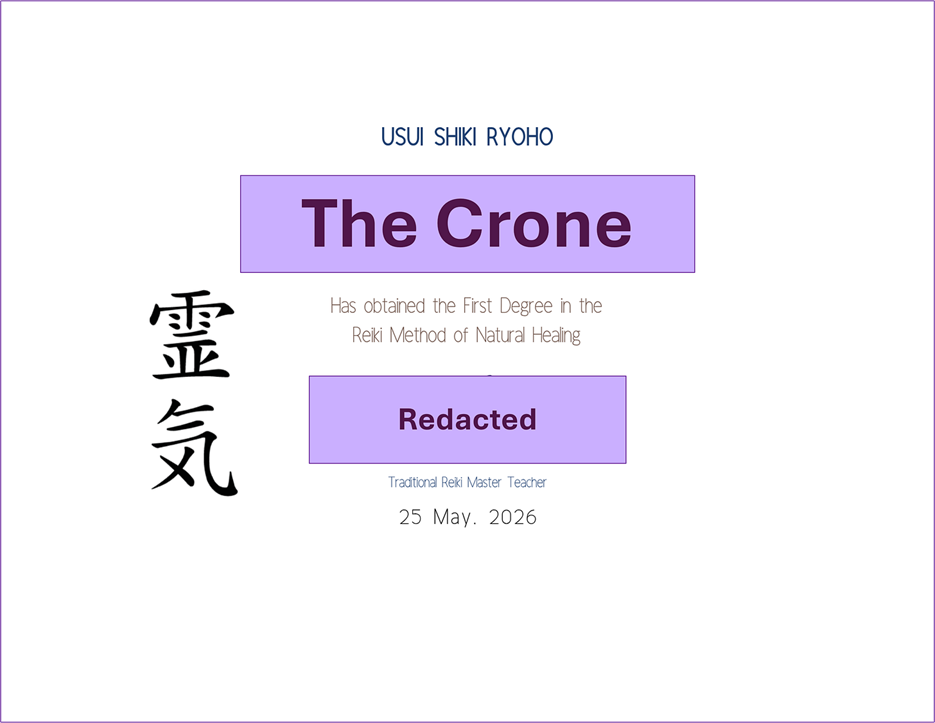
A year ago, I never dreamed I would unironically write that sentence, but a year ago I had not yet released my inner crone.
Today I am going to take all you crones on a deep dive into articles that illustrate the tension between the scientific and the Reiki community, and give my thoughts on how we could bridge that gap.
Reiki and Me
The first time I heard the word Reiki was during my internal medicine residency orientation. During one of those “share 3 interesting things about yourself” icebreakers that everyone hates, one of my new coresidents said she was a Reiki Master. We looked at her like WTF is Reiki? When she said it was energy healing where you hovered your hands over someone, we scoffed.
That incident clearly made an impression on me as I remember it (**cough cough**) number of years later. Looking back on it, I want to apologize to my co-resident, the amazing Reiki Master internist. You are awesome, and your patients are lucky to have such a talented and open-minded physician.
Fast forward to me, the scoffer, in my Reiki Level 1 certification course. I not only quickly consumed all the course materials, but I also read 2 reiki books, listened to 1 audio book and 1 podcast series, and read multiple online resources.
While nerding out, I kept seeing the same clearly bad science quoted almost verbatim in each source—The Masaru Emoto water experiments. More on Emoto later including, why his studies make my head explode, contribute to people scoffing when they hear the word Reiki, and do a major disservice to the Reiki community.
Synchronicity
Within an hour of getting my Reiki 1 certificate via email, I also got an email invitation to peer-review an article for the leading academic journal in my field. I peer-review for them about every 6 weeks, so that invitation wasn’t unusual. But seeing the emails back-to-back sparked an idea.
What if I wrote a post where I reviewed Reiki studies?
Confirmatory synchronicity—Just as I was putting the finishing touches on this post, I got a text asking me to teach my annual ‘how to give a journal club’ to the statewide palliative care fellowship consortium for the fifth year in a row (aka teach all the palliative care physician trainees in the state how to evaluate and report literature). Of course I said yes. I love geeking out and teaching others to geek out.
I think the universe is telling me I was meant to write this and that you were meant to read it. Buckle up, Buttercup.
Enter today’s post.
I started off thinking I was going to compare the Emoto water experiments with a high-quality Reiki study and share tips on how to identify good and bad science.
I worried it was a little dry and I almost shelved the idea.
But everything took a hilarious turn when I found the editorial below.
We HAVE to go down the rabbit hole together.
I’m going to take you on a journey through the most bonkers editorial I have ever seen in an academic journal, the Emoto experiments, what I found when I went looking for good Reiki science, and what I still want to see.
I stumbled across the unhinged editorial while trying to take a methodical approach to finding high quality Reiki studies. I went to PubMed, the primary database for health science journals, and I put in the MeSH Term “reiki therapy.” 349 Articles popped up dating back to 1994.
For those not used to searching PubMed, 349 is not a lot of articles for a broad topic area like this.
I started scanning the titles and journals to narrow things down. I was looking for articles in top journals (NEJM, JAMA, Annals, etc).
Nada.
So, I looked for articles from decent journals (ie no newsletters, predatory journals, non-peer-reviewed journals, etc.). I decided not to include articles from journals with words like complementary, alternative, and holistic in the title. Those journals aren’t necessarily bad. I was just hoping to find something in “mainstream medicine” for the skeptics.
Then It Happened
I was stopped in my tracks by article #255. Witchcraft and Reiki: Voodoo Economics and Voodoo Healing. After skimming tons of dry scientific titles you would probably pause there too.
Weissmann G. Witchcraft and reiki: voodoo economics and voodoo healing. FASEB J. 2009 Jun;23(6):1617-21. doi: 10.1096/fj.09-0601ufm. Erratum in: FASEB J. 2009 Aug;23(8):2790. PMID: 19487318.
In the name of nerd-dom and methodology, I forced myself to keep skimming all 349 titles and journals. But I couldn’t stop thinking about the Witchcraft and Voodoo title.
When I finished, 18 of the 349 articles fit my criteria, but there was only one article I wanted to read immediately. The witchcraft, reiki, and voodoo one.
I highly encourage you all to read it. You will laugh. You will cry. You will scream. Maybe not in that order.
Introducing the Bonkers Editorial
We are going to talk about an editorial in the FASEB Journal (Federation of American Societies for Experimental Biology) written by the Editor-in-Chief.
FASEB is not a top journal, but it is considered in the top quarter in its field. It is peer-reviewed and respectable.
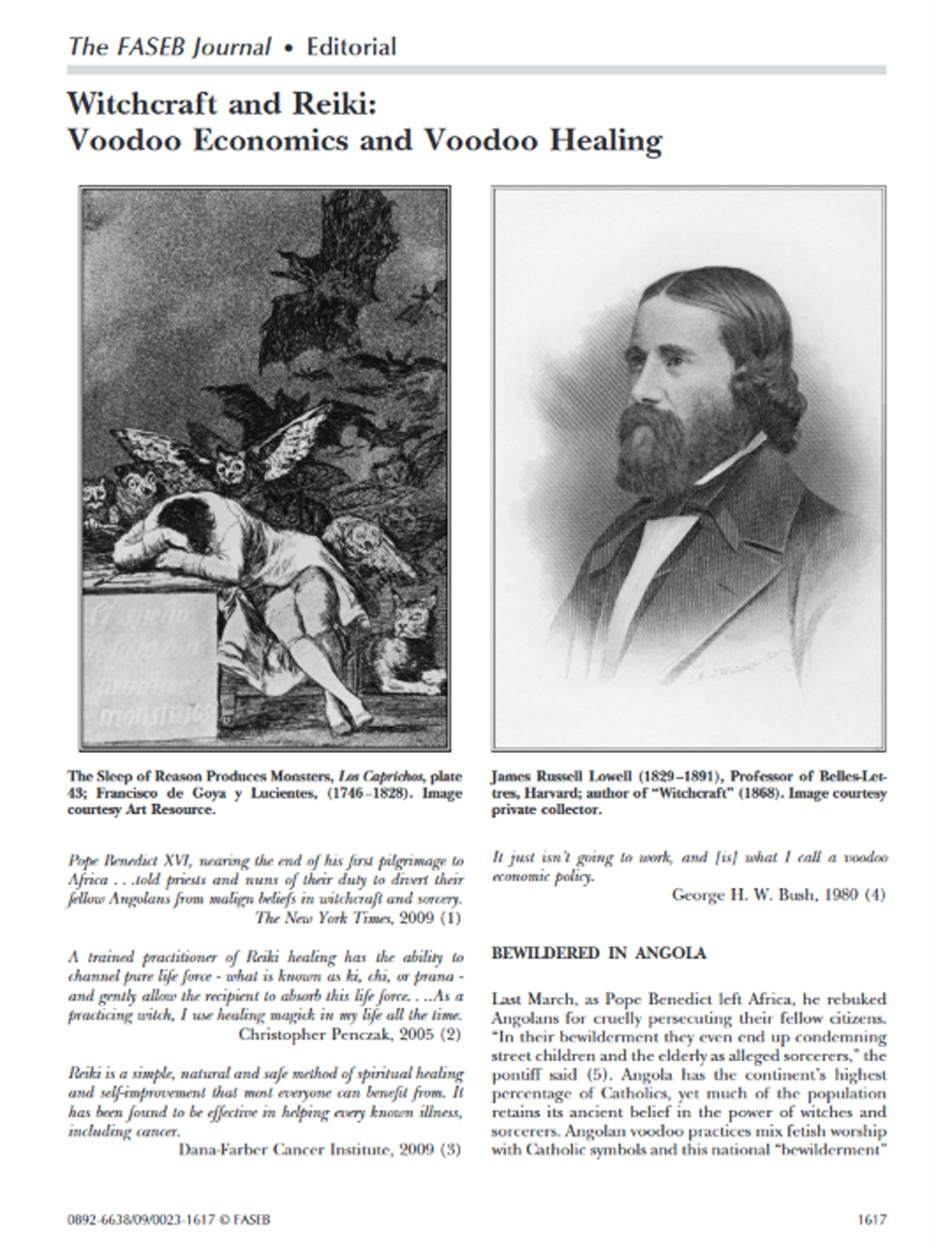
The first page signals how unhinged it is better than I ever could, so I posted it here for you.
It opens with the images: The Sleep of Reason by Francisco de Goya y Lucientes, and a picture of James Russell Lowell, a Harvard Professor who wrote “Witchcraft” in the 1800s. Check out the highlighted quotes after that including one from George H.W. Bush.
Even laypeople can see this is not the typical editorial from the editor-in-chief of a respectable medical journal
Now Let’s Jump to the Main Text
We immediately encounter a long quote from Pope Benedict XVI about child abuse in Angola. You will come to find out Weissmann loves quotes. This particular quote is quite graphic and disturbing.
Trigger Warning: If you want to read the article and graphic discussion of child abuse is triggering to you, start on the first full paragraph on the second page beginning with “Evil or not, many children…”
Weissmann uses the Pope’s quote to argue that the horrible torture and killing of children in Angola accused of witchcraft are due to Voodoo practices and beliefs.
But what does the Pope actually say?
The Pope laments that this atrocity is happening in the African country with the highest percentage of Catholics. He says Angolan voodoo practices mix fetish worship with Catholic symbols and much of the population retains its ancient belief in the power of witches and sorcerers. He does not say Voodoo practitioners are perpetrating the violence. He says the accusations of witchcraft, violent exorcisms, and child abuse come at the hands of Pentecostal clerics.
But what does Weissmann take from it?
He chooses to blame the religious tradition least familiar to himself and to his Western readers for this egregious human rights crisis.
This sleight of hand—intentional or not—made me pause.
But wait! He takes it to a whole new inflammatory level
Weissmann conflates the “voodoo-related” human rights violations in Angola with the “comeback” of witchcraft in Massachusetts. He says the witches in Massachusetts “favor” Reiki. Then he says Harvard is doing “voodoo healing.”
What is this voodoo healing? You guessed it, Reiki!
Voodoo and Reiki do have a lot in common. I can see why he confused them. I mean, both of their negative western stereotypes are rooted in racism. Voodoo gets a bad rap tracing back to the slave trade and the Haitian slave rebellion. Reiki came to America during WWII when we were simultaneously putting Japanese Americans in internment camps and denigrating all things Japanese. Both are “other” traditions which makes them scary.
Whew. That is a lot. If you need a moment to process the leaps in logic, go ahead and walk around the block, take a sip of your favorite calming tea, or primal scream into a pillow—your choice.
Moving on to Witches of the World Unite
In the next section, Weissmann pivots to a piece in the Harvard Medical School’s Health News Letter recommending Reiki. He shares a benign sounding quote from the newsletter discussing practitioners ‘using gentle touch with the intent of affecting the body’s energy fields…in an ordered sequence.’
Weissmann’s response to the quote and the newsletter:
“Reading this twaddle on a spring day in Woods Hole, Massachusetts, it seemed to me that Pope Benedict could well issue a warning against ‘bewilderment’ in Massachusetts. The Bay State is positively awash in witches, sorcerers, and Reiki fanciers.”
Twaddle? Bewilderment? A warning from the Pope akin to the one in Angola? Awash in witches, sorcerers, and Reiki fanciers?
Weissmann then talks about several modern-day witch groups in Massachusetts. He seems upset they focus on friendship, acceptance, and spiritual healing.
He really zeros in on this guy, Christopher Penczak who had the audacity to write a book titled “Magick** of Reiki: Focused Energy for Healing Ritual and Spiritual Development,” AND (gasp!) hold a book signing.
Weissmann gives a quote from Mr. Penczak and frames it as Mr. Penczak rejecting science. In the quote Mr. Penczak claimed Reiki healing can occur on emotional, mental, or spiritual levels. He does not say Reiki works on a physical level or that it replaces medicine.
** Note Penczak spells Magick with a K (as does Weissmann for most of his editorial). Magick with a K is different from Magic. Magick is a modern Western Occult practice related to Aleister Crowley (a very problematic dude).
In the same section, Weissmann shifts his ire to Harvard’s Dana-Farber Institute. Why? They had the audacity to put side effects of Reiki therapy on their website, just like they would for any other medical treatment.
My Two Favorite Weissmann Quotes Are Up Next
When talking about the National Center for Complementary and Alternative Medicine (NCCAM), Weissmann lifts what appears to be an incomplete quote from their website talking about distance Reiki.
His hot take on it.
“If that ain’t Voodoo, I don’t know what is…as they say.”
I tried to access that source that made him say this, a now defunct NCCAM website from 2009. The current page says: “Reiki hasn’t been clearly shown to be effective for any health-related purpose. It has been studied for a variety of conditions, including pain, anxiety, and depression, but most of the research has not been of high quality, and the results have been inconsistent.”
Next, he declares
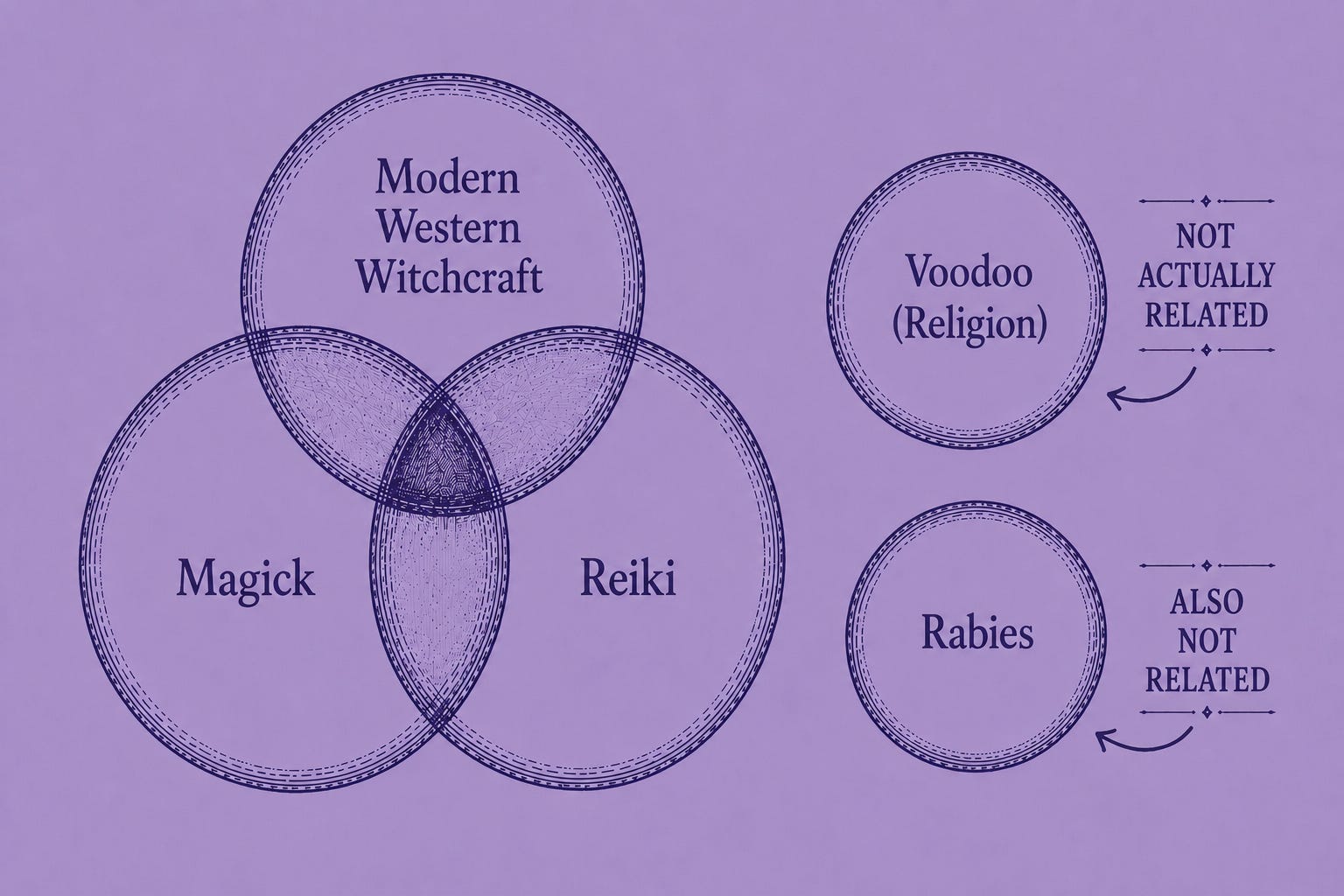
“Like rabies, Reiki and witchcraft have crossed the Cape Cod Canal”
Why does he compare Reiki moving through Massachusetts to a 2004 rabies outbreak in the area?
Well, there is a Witch School in Provincetown “a stone’s throw” from the “labs at Woods Hole,” and he says “where magick thrives there lives Reiki.”
Really?
Why does it matter if there is a witch school near a lab? Does he think they are hexing the experiments?
And has this guy ever heard of a Venn diagram?
The Next Section Almost Seems Like it Will Land.
But…We Already Know it Won’t.
Weissmann quotes a Lowell 1868 essay on the Salem witch trials
“Credulity, as a mental and moral phenomenon, manifests itself in widely different ways, according as it changes to be the daughter of fancy or terror.”
Weissmann’s purpose for using this quote is to say people should be incredulous about modern witchcraft in Massachusetts because it is a flight of fancy, and they should be incredulous of witchcraft in Angola and old Salem because it invokes terror. He is saying no matter which way you view witchcraft (and by his logic Reiki) it is bunk.
I interpreted the quote in relation to Weissmann’s credulity. This article is his flight of fancy, and it is capitalizing off others’ credible terror.
Bringing it Home With Voodoo Economics
Weissmann starts this section by singing the praises of Lowell for a few paragraphs. Cool. The dude could write.
Weissmann’s selected quotes from Lowell here reveal that Lowell attributed the witch-hunts in Salem to ageism, the patriarchy, and capitalism (those are modern terms, but I’m writing for a modern audience).
Ageism: Weissmann shares a quote by Lowell by talking about the short life expectancy in Salem and how those who lived longer were an anomaly, a biological curiosity and had been described as having made a pact with the devil.
Patriarchy: Lowell seems to describe society’s views of “Nasty Women,” especially older ones about 150 years before the term was coined.
“Unhappily there were always ugly old women; and if you crossed them in any way or did them a wrong…they could send a demon into your body, who would cause you to vomit pins, hair, pebbles, or knives.”
Capitalism: Lowell was pretty forward thinking. He hinted at witch-hunts being tied to the “trade in souls.” Each soul is an entity to be “saved” or “lost,” hence the unholy contracts with witches and the devil.
Weissmann ties the concept of the “trade in souls” to the economics of witchcraft and Reiki today. Not the sales of candles, crystals, services, etc, but grant funding through NCCAM. He cites over half a billion dollars spent in the previous four years funding “voodoo sciences such as Reiki, aromatherapy, and homeopathy.” Money he claims is being taken from “cures” to diseases, based on one negative fibromyalgia study. Someone who edits a peer-reviewed journal should KNOW that one study is not enough to draw any real conclusions.
He chooses to wrap up his 4-page tirade with a quote from George H. W. Bush. Because at this point, why not?
“In the prophetic words of George H.W. Bush on Reaganomics: ‘It just isn’t going to work, and [is] what I call a voodoo economic policy.’”
His editorial was retracted two months later on August 1, 2009.
This is all the retraction said:
“In the article, “Witchcraft and Reiki: Voodoo Economics and Voodoo Healing,” by Gerald Weissmann, which appeared in the June 2009 issue of The FASEB Journal (doi: 10.1096/fj.09 – 0601ufm), the word “Reagonomics” appearing on pages 1620 –1621, should be spelled “Reaganomics.” This article has been corrected online. doi: 10.1096/fj.09-0601ufmerr”
What a reason for a retraction. It wasn’t the racist conflation of unrelated cultural traditions. It wasn’t the dismissal of an entire field based on one study. It wasn’t even the misspelling of Rieki earlier in the editorial. The correction was for the spelling of Reaganomics.
That Editorial Was Bonkers. But How Does This Apply To Crones?
As messed-up as this editorial is, it inadvertently makes a good point about Cronedom.
If you are a crone, congratulations! You have likely made it past the average life-span of people in Angola and old Salem.
In both places, people didn’t live much beyond 40. When people don’t live very long, those who orbit the sun the most times appear unnatural. It is not a big jump to call them supernatural.
By virtue of our age, many of us crones would be accused of witchcraft 325 years ago.
Are we avoiding the accusations now because, at least in the west, there are more crones per capita?
Maybe, maybe not. We have other names for it now. Nasty Woman, assertive, bitch, etc. If you are older, you are typically on the margins, and you do not make yourself small for others or care what they think? Guess what? You are a witch. Not literally, but if you actually are I love that for you!
And what is wrong with being a witch? I mean, there are days that I wish I could send a demon into someone who “crossed [me] in any way or did [me] a wrong” to make them “vomit pins, hair, pebbles, or knives.”
Why is Science Hating on Woo and Reiki so Much?
“Not everything that can be counted counts, and not everything that counts can be counted.”
- William Bruce Cameron
We have scientific purists, like Weissmann, arguing only data, logic, and “counting” matter. And we have people like Reiki practitioners talking about what “counts” and not how to count it.
Similar. Different. Both very much needed to help the human condition.
Weissmann’s vitriol and the people who allowed it to be published make it clear why people in the woo community don’t like or trust science.
But what gets people in the scientific community so riled up against the woo?
Some of it seems to come down to language. Putting on my doctor hat “healing” has a very different meaning to me than when I put on my Reiki hat. One deals with cures and evidence-based improvements of the physical. The other deals with spiritual and emotional healing—that sometimes can assist with physical healing too.
Just like Weissmann wading into territory he didn’t know about with spirituality and ultimately sounding foolish, the woo community sounds foolish when it wades into science territory.
Speaking of Sounding Foolish—Masaru Emoto. Don’t people. Just don’t.
Emoto tried to prove that water responds to words and intention. The appeal isn’t irrational. It is a gorgeous idea, water making beautiful crystals in response to love. The problem is it was never tested rigorously enough to know if it is true.
His work is touted in tons of publications about Reiki. It is repeatedly used to “prove” Reiki works.
I’d much rather hear I don’t have proof Reiki works, but it makes me feel good rather than for people to quote such shitty “science.” Shitty science is fodder for skeptics like Weissmann point to as a reason to tear down funding opportunities for good science and expansion of Reiki.
Excuse my French. I feel strongly about pseudoscience.
Pseudoscience is used to justify things like refusing life-saving healthcare and vaccines (THEY DO NOT CAUSE AUTISM), denying climate science, and darker things like eugenics. Note—I am not comparing Emoto to eugenicists. He is promoting light and love. His methods are just misguided.
Why do I dislike the propagation of Emoto’s work in the Reiki world?
Well, within the first 30 seconds of hearing about it my bullshit detector went wild. Like I literally felt the heat rise in my body and my chest tighten. And this is after I already bought into Reiki enough to be in a training. Imagine people who have dug their heels in as skeptics.
So let me talk you through why Emoto’s work caused a visceral response.
First, his methodology is so poor he couldn’t even get it published in a peer review journal. Not a single peer-reviewed article.
Emoto has 2 PubMed indexed articles.
The first is a photo essay in the Journal of Alternative and Complementary Medicine. Yes, this is a peer-reviewed journal, but a photo essay is not a study. It also seems to promote his book?
The second is in Explore (NY) a non-peer reviewed, predatory journal (aka) a journal that constantly solicits articles and charges people to publish. Currently Explore (NY)’s website says it costs $2510 to publish an article with them.
In his photoessay “study” he “proves” that Reiki changes the structure of water. How? He wrote words like “Love & Thanks” or “Devil” or “You Fool” on slips of paper in different languages and wrapped them around water bottles for 24 hours. He froze them and said the positive words made beautiful crystal under the microscope and the negative ones made no crystals or the crystals weren’t beautiful. He did the same thing with classical and heavy-metal music.
Hmm…
As someone who has done microscopy in a research lab before, I know you can just scroll until you find a pretty picture that backs up your hypothesis. No mention of his methodology to prevent this.
His predatory journal publication uses a lot of words that sound scientific starting with the Title: Double-blind test of the effects of distant intention on water crystal formation. There are so many things wrong with this study I’m just going to bold each part that sets off my Spidey-sense and italicize the words that are meant to make it sound scientific.
He has 100 people do a prayer of intention over 2 bottles of Fiji water and leave 2 un-prayed over. It takes him 36 hours to ship the bottles to his lab. Then he freezes the water in petri dishes in a walk-in freezer. Okay—if you want to freeze a process in a scientific study you do it immediately. He takes the apex of the drops from each petri dish and looks at them under a stereo-optical microscope. 40 pictures are taken from the bottles (different numbers of pictures from each bottle). He says they did not take pictures from the bottles with no crystalline shapes. He says the person taking the pictures is blinded but in the discussion, he says the water from each bottle was grouped together in the freezer. He has 100 people blinded to assess how beautiful each crystal image is on a scale of 1-6. He defines beautiful as symmetric and aesthetically pleasing shapes. (Good for him defining terms—kind of). He randomizes the order of the pictures. BTW he doesn’t describe the judges or say how they were selected. He justifies their judgment by confirming it with a group of 100 other judges. In the discussion he admits what they did was subjective.
Another Water Study?
Another group of scientists tried to replicate the study in a more rigorous way. Instrumental Measurements of Water and the Surrounding Space During a Randomized Blinded Controlled Trial of Focused Intention. They used fancier equipment and methods that sounded almost plausible. They even used sham and control water too.
But…this group only reported the results for the experimental water. Doh!!!
No sham reporting. No control reporting. No comparisons between groups. Something is fishy.
Okay, so these water studies suck. What about studies on people?
Well, remember how I found those 18 articles on my quick first pass in PubMed? I went back to read them. Not a single one had sound methodology.
I tried other search terms, and I came up with one potential—but it was behind a paywall and my institution didn’t subscribe to the journal. So, I put in an interlibrary loan request. In total I looked for about 3 hours using all the search tips and tricks I knew and found nothing else.
In that search, I came across two Cochrane reviews. If you don’t know what Cochrane reviews are, they are considered the gold-standard of systematic reviews in health-care research.
Cool! Maybe I missed a study, and these reviews would point me in the right direction.
Well nuts.
The first review says there is insufficient evidence to say whether or not Reiki is useful in people over 16 years of age with anxiety, depression, or both. The other said “We are uncertain if Reiki plus analgesia compared with analgesia alone has any effect on pain, adverse effects, vital signs, or rescue analgesic requirement because the quality of evidence is very low (one study, 90 women).
This One Has Potential
Just as I lost all hope, the interlibrary loan came through. It was for an article published 4 months ago looking at the impact of Reiki on analgesic use, blood pressure, heart rate, and respiratory rate in ventilator patients in an ICU.
Karacan Y, Parlak AG, Ertem AC. Effect of Reiki on Pain, Anxiety, and Hemodynamic Parameters in Mechanically Ventilated Patients: A Randomized, Single-Blind, and Placebo-Controlled Trial. J Integr Complement Med. 2026 Feb;32(2):165-173. doi: 10.1177/27683605251384808. Epub 2026 Feb 18. Erratum in: J Integr Complement Med. 2026 Feb 28:27683605261422726. doi: 10.1177/27683605261422726. PMID: 41051913.
This is the best study I have found. Why? The population is sedated. They cannot fake their responses—especially their vital sign responses. It is sham controlled. The scales used for their pain and anxiety scores are validated. They use appropriate statistics. They acknowledge (most) of their limitations.
Oh, and this manuscript had an errata too. It was due to an error re-formatting their tables after a peer reviewer had them go back and fix their statistics. A far cry from the retraction for the Weissmann article because of “Reaganomics.”
Their main limitation—the bedside nurse was the one who knew whether the patient was getting real or sham Reiki. And guess who decides if a patient needs pain meds and gives them? The bedside nurse. The study’s most impressive finding was that 1 out of 30 Reiki patients needed pain meds and 13 out of 30 sham Reiki patients needed pain meds. But the bedside nurse’s double role is troublesome.
But this was by far the best I could find.
So, after the water studies, other poorly designed studies, and overall lack of evidence, you can see why the scientific community is leery of Reiki. And the way the scientific community talks about Reiki you can see why they are leery of science.
What is a scientifically minded Crone interested in Reiki to do????
I teach my trainees to end every journal club with the study they’d design to fix what’s broken. Here’s mine.
A real double-blinded RCT where nobody, not the participants, not the research team, knows who’s getting the real thing. Four arms: real Reiki, sham Reiki, distance Reiki (kept blind to their own waitlist status), and an actual waitlist control. A clearly described population, with real inclusion and exclusion criteria, so we know who we’re talking about. One or two primary outcomes, chosen in advance. I’d want them to be physiologic like vital signs, cortisol, inflammatory markers, maybe something looking at connective tissue, since that’s where practitioners say the energy moves. Everything else like pain, anxiety, depression, quality of life can be secondary, not primary, because these subjective measures are too easy to wish into significance. A power calculation, so they actually enroll enough people to find something real if it’s there. Full reporting of all the data, not just the flattering parts. Honest limitations. Transparent funding — NIH, a Reiki foundation, big pharma, Jeff Bezos, whoever, just tell us. And most of all: a willingness to be wrong.
If you want to build something like this yourself, the CONSORT guidelines exist for exactly that. If you just want to get better at reading studies and sharpening your bullshit detector, the JAMA Users Guide to the Medical Literature will do it.
In Conclusion
Maybe someday people will study Reiki in a way that fits these criteria and holds up to scrutiny. And maybe that is the day that science and woo can live together in harmony. The ICU Reiki from 4 months ago gives me hope.
After reading this post, it may seem like I am anti-reiki. I am not. I am anti-science hating on the woo without exploring it. I am anti-woo claiming science backs them up and using pseudoscience as proof.
I will close with the last question I like to ask when interpreting a study.
Will it change my clinical practice? No.
I will not let the literature we reviewed here cause me to abandon my Reiki practice. I am a proud academic geriatrician and a proud Reiki 1 certified practitioner who hopes to become Reiki 2 certified at some point! Both worlds can exist together if we keep open minds and hearts.
THE END
If you made it this far, you probably have been thinking deeply about how we interpret science. Maybe even how we interpret everything in our daily lives. If so, I will leave you with a journal prompt to help you work through those thoughts:
Have you ever dismissed or accepted something without really looking at it? What made you so sure you didn’t need to?
The content on Crone Powers is for informational and entertainment purposes only. It does not constitute medical advice. I am a doctor, but I AM NOT YOUR DOCTOR. Always consult your medical and mental health professionals before ADDING—NEVER SUBSTITUTING—spiritual modalities to your care. Remember, woo only works when you do the work.
The views and opinions expressed here are my own and do not represent those of my employer or any institution with which I am affiliated.