


“Point your feet to where you wanna go. Okay? And then you just catch yourself before you fall.”
-Alberto from Luca (Disney 2021)
“Falls are the leading cause of death for adults over the age of 70. For example Alice from the Brady Bunch, Kurt Vonnegut, and”
BOOM
Down I went. Eight months pregnant. In the middle of a talk about falls at a scientific conference.
I was told to watch out for the legs of the screen for the projector. I’d laughed. I was invincible.
I was in a room full of doctors. Only the one in the front row popped up—immediately with a look of fear on her face. But I was young. I popped up too. Before she could get to me, I’d picked up where I left off.
…”William D. Bechill, the US’s first Commissioner on Aging. So, you can see, knowing about falls and aging isn’t enough to prevent falls.”
Nervous chuckles from the audience
I realized I needed to say something.
“I’m okay. I’m lucky my only injury is my pride.”
More nervous chuckles and I plowed ahead.
The show must go on.
And yes, I was lucky. It could have been a disaster. I could have landed on the baby. I could have stretched out my hand to catch myself and broken my wrist. But youth and luck was on my side.
My patients often aren’t as lucky. Falls are the number one cause of accidental death in people over the age of 70—one third of the deaths as a matter of fact. And that leaves out the disability that comes in their wake. Hip fractures don’t always kill you (quickly). But about a quarter of people who fall, break a hip, and get surgery within 24 hours still die within a year. Almost three quarters of those who don’t get surgery are dead within a year. You could argue that’s because those who don’t get surgery are sicker, but that is missing the point. A shit ton of people who fall and fracture a hip die within a year.
Why aren’t we talking about this more?
I mean, we know that gait speed predicts mortality in people over the age of 65, but there is no specific place to record that in the medical chart and most clinicians don’t even know gait speed is a thing let alone measure it.
Okay. This Crone is getting off her soap box. I’m here today to talk about what we can do to prevent falls. There is tons of good evidence out there on what we can do to prevent such horrible outcomes.
#1—Talk about it in medical visits. Doctors don’t bring it up for a variety of reasons. Preventative interventions often fall to the wayside when there are other medical problems to address. Also, most people don’t have a lot of training in falls. Oh, and the billing for falls is a joke. Check out the insane number and type of crazy ICD 10 (billing) codes for falls. Note they are all about fall related injuries—not prevention. My favorite are falls from a cliff and falls from scaffolding. How often are those used? Why else don’t we talk about falls? Patients don’t bring it up because they don’t think it is a medical problem. They don’t realize that tripping causing them to accidentally sit in a chair is a fall. They are terrified they will lose their independence if they admit to falling. Doctors and patients seem to have an unspoken mutual agreement that we will medically ignore falls until they are an emergency.
Doctors love guidelines. Give us a good algorithm or decision tree and tell us it is evidence based and we will take it as gospel.
Guess what? We have a guideline for fall prevention, and I’m going to let you in on it. Now you know the way we should be thinking about falls.
It all starts by asking everyone over the age of 65 if they have fallen. Not just asking, acting on what we find out.
Introducing the STEADI Guidelines from the CDC. These guidelines were here BEFORE the new CDC and their dismantling of scientific evidence. Falls aren’t scandalous. It is just our lack of attention to them that is scandalous.
STEADI stands for Stopping Elderly Accidents, Deaths & Injuries. I’ll forgive the use of the word “Elderly” here because it makes a better acronym than “Older Adult”. SOAADI doesn’t have the same ring to it.
The website has tons of information for clinicians and for patients here. I’m going to post my reproduction of the flowchart from the guideline for you.
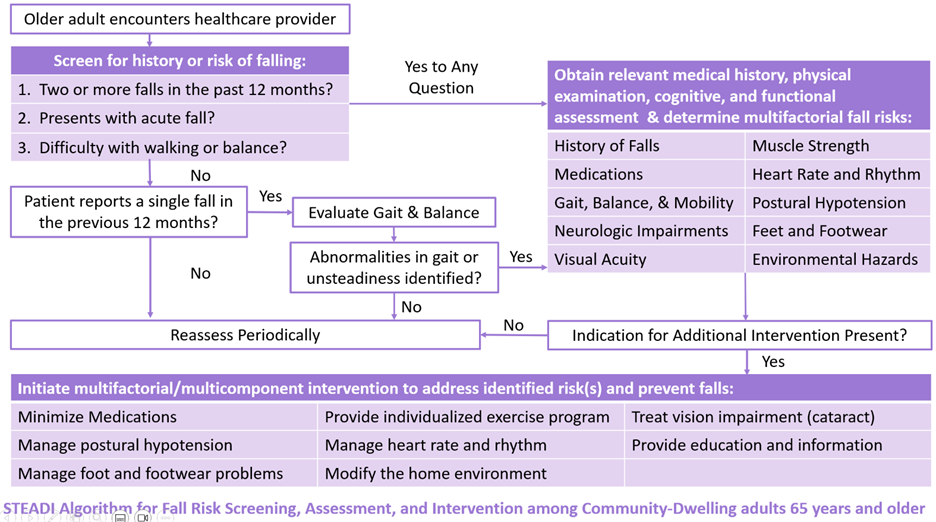
What does all of that mean? It means that we need to ask more about falls, and when we find out someone has fallen (not just the dramatic ones to the ground, but the slips, the catching yourself on the furniture, etc) we need to do something about it.
First ask more questions. Then dive deep. Each of the points in the chart can be hours of lectures to trainees. Here are my snarky ways to remember what needs to be done if you are falling.
Stop the don’t ask don’t tell. Let’s dive deep about your falls.
Age doesn’t cause falls. Meds do. Talk to your prescriber about which ones.
Weebles Wobble But They Don’t Fall Down—your gait & balance should be checked.
Check ‘ya head—is there a neurologic problem and if you fell, a bleed?
I can see nearly now—check vision, be careful with new glasses, remove cataracts
Asking for help isn’t weak—but your legs may be. Let’s look.
Don’t go breaking my heart (or your hip). Get your heart checked out.
Stand up under pressure. Does your blood pressure drop when you stand?
Watch out for slippers, they tell you what you’ll do. Check your shoes and your feet.
Clean up your act, ‘ya filthy animal. Have a home safety assessment.
That’s a lot. What’s a crone to do if they are worried about falling?
Make sure you talk to your doctor about it. Falls are a medical problem. Many are preventable, and we CAN do something about it. Your doctor will evaluate you and depending on what they find, they could suggest medication changes, balance exercises, cataract surgery, blood pressure or cardiac interventions, footwear changes or referrals to podiatry, physical, occupational, or vestibular therapy, home safety assessments, assistive devices, and general education. There is no one size fits all intervention for falls and seemingly small changes can make a big difference.
If I could share one thing about falls with my fellow crones, it is this: Break the silence. If you or a loved one are falling, don’t hide it. Falls don’t make you old, but they do have the potential to make you lose your independence or even your life.
Anyone can fall. I fell as a pregnant young crone. I was distracted, my center of gravity was off with an 8-month pregnant belly, and there was an environmental hazard with the screen stand. Another crone could fall because their diabetes medications are too strong, they got new multifocal glasses, they have a bum knee, or a new heart problem. Talk to your doctor. By working together, you can greatly reduce your risk of falls and injuries.
And remember, if you are falling, suck it up buttercup and ask for help. Pride goeth before a fall.
The content on Crone Powers is for informational and entertainment purposes only. It does not constitute medical advice. I am a doctor, but I AM NOT YOUR DOCTOR. Always consult your medical and mental health professionals before ADDING—NEVER SUBSTITUTING—spiritual modalities to your care. Remember, woo only works when you do the work.
The views and opinions expressed here are my own and do not represent those of my employer or any institution with which I am affiliated.