

I reach for my badge to get into the building, and I’m briefly disoriented that all but one is missing. I remind myself I retired and now occupy an awkward liminal space on faculty.
I’ve taught in almost every classroom here. As I approach today’s room, my nervous system responds with chest tightness and face flushing. It was in this room, just prior to retirement, that I realized I’d given this place more than I ever should have—especially more control over my emotions.
You know how they say it’s a marathon and not a sprint? Academic medicine is all sprints. When I opted to get off the treadmill I was met with confusion and pity—and I dread those looks and conversations today. I remind myself that I am here for the fellows, and that right now nothing else matters.
I take a deep breath, rub the ocean jasper in my pocket, open the door, and walk in.
Three second-year fellows excitedly say hello and express surprise and joy that I am back. I was their program director just a few short months ago. I exhale the breath I didn’t realize I was holding, smile, and take my seat.
Why am I here orienting the new geriatric medicine fellowship class despite stepping down as program director in February and retiring in April? Because Words Matter, and I am here to give a talk by the same name.
Words are magic. They shape the way we think and act. The words we use when talking about aging have been heavily culturally influenced to lean negative. Words with negative connotations shape the way we view others, set up systems, and interact with the world.
I get pretty fired up about this, and I guess that is why they invited me back to speak instead of just handing my slides over to someone else.
I spoke to them about implicit bias in aging and brought up Grandpa Simpson as an example in the media. His fairly one-dimensional characteristics are that he falls asleep, drools, asks repetitive questions, and tells nostalgic stories. With images like this permeating popular culture and media, no wonder we subconsciously incorporate ageist ideas and words into our everyday language.
Why does this matter in medicine? Medicine makes Herculean efforts to save lives, but the system isn’t built for caring for us into old age after our lives have been saved. We exclude older adults from research. We say things like, ‘of course you have aches and pains at your age’ or ‘it is normal to forget things at your age.’ In case you are wondering neither of those things are normal.
Guess what? No matter our level of privilege when we are younger, we will be marginalized as we age. Why do our younger selves do this to our future selves? We can go down that rabbit hole another time. But language feeds into the othering as we age.
If you are still with me, you are probably wondering what words we should use to try and avoid othering older adults?
Avoid they/them. Not the personal pronouns, but using they/them to refer to the whole demographic. Instead use we/us, all of us, as we age, etc. Ex. Not—When the elderly fall, they are more likely to have serious injuries. They can prevent falls by exercising more. Instead—As we age, falls are more likely to cause serious injuries. We can try to prevent falls by exercising more.
It killed my soul to write elderly above. I cannot stand that word.
It seems innocuous. We use it all the time. But think about how you use it. Research shows it connotes incompetence as does the word senior.
What word should we use instead? The research says older adult implies competence and is less likely to other the demographic.
My hatred of the word elderly was kind of legendary in the program. Prior trainees would see me grimace when I overheard the word from others, and the flash of anger in my eyes if they used it. It became a joke and then a meme. I promise you, I don’t say ‘girly’.
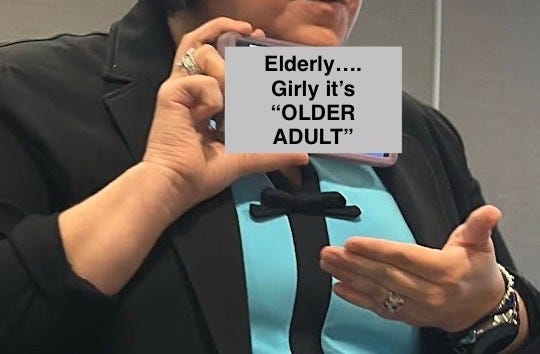
I ended my talk with the (full sized) meme. It got a laugh.
I almost followed it with my crone picture as an example of using the words people choose for themselves, but I realized I’d rather talk about that with you.
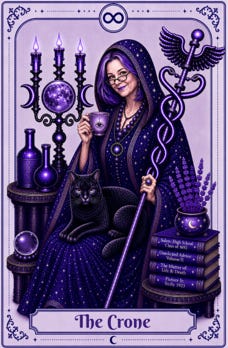
Crone likely means something different to each person reading this. I use it tongue-in-cheek as a way to reclaim negative stereotypes.
In preparing for this post, I decided to read a little more on the etymology of the word crone. Did you know it came the French word “charogne” meaning carrion? Old disagreeable (ie independent) women were equated with rotting dead animals. Cute.
The first time it appeared in English literature was in Chaucer’s The Canterbury Tales in The Wife of Bath’s Tale. Who knew this post would veer to Chaucer—not me—I’m not really a literary person. But when I learned this tidbit, I immediately and voluntarily read it. Luckily, I found a modern translation instead of the Middle English one I was forced to read in high school.
Guess what? To Chaucer, the Crone isn’t carrion at all. She is a kick ass older woman—or rather two kick ass older women. The crone in the story, and the one telling the story. It takes one to know one.
In this story within a story, we learn about a knight who commits a crime and is given one chance to save his life: discover what women most desire. “Nobody” knew the answer. At least not the people society usually turns to: the young, the powerful, the leaders.
Only the crone knows and nobody thought to ask her.
She speaks up and tells us that women want sovereignty, the right to rule themselves.
Chaucer ultimately ruins this amazingly feminist revelation. Because she gave him the answer, the knight marries the crone, but he is upset that she is old and ugly. She gives him one final test. He can choose for her to stay old but faithful or be young and beautiful but not faithful. He tells her to decide, giving her sovereignty. She rewards him for getting the right answer—by turning into a young beautiful woman.
So close, Chaucer. So close.
I knew none of that about the word crone until I stared writing this post.
So why do I call myself a crone? Well—connotation has deep roots in etymology whether we know it or not. And, in my longwinded academic rant above, I hope I proved connotation matters when talking about aging.
Crone is a dirty word to some. It can be equated with old, ugly, evil, witch, hag, and so on. But, especially when we look at the maiden, mother, crone archetypes, crones are the wise women. The ones who have claimed their sovereignty. The sovereignty others don’t even realize women want or need. The sovereignty they spent their maiden and mother years squelching. The sovereignty that scares people and leaves them speechless and unnerved by your pure joy in abandoning the work you had taken on when you thought you had to perform for love and approval.
When I talk about my crone awakening, I was invoking Chaucer and I didn’t even know it. Channeling my inner crone is allowing me to go after what I most desire. Sovereignty. The right to rule myself. I had abandoned that, and myself. Maybe I never had it.
Now, deep in my fuck it forties, I am claiming my sovereignty. Crone is the very best word for the powerful feeling of audacity, nerdiness, and wisdom, that I now want to embody.
And you know what? I think I’ve gotten so fired up about the words we use to describe aging in the past because of the self-sovereignty that I implicitly knew was missing not just in me but for many older, female identifying, and marginalized people. Now I’m able to explicitly link my passion for ensuring dignity and respect for older adults, and my draw to the word crone and the crone lifestyle.
It is all about self-sovereignty. And now that I am aware of this (thank you Chaucer) I will even more enthusiastically take up the crone mantle. It is time to stop performing for other people’s approval. It is freeing and also very fun to watch the confused reactions of those who knew you prior to your awakening.
Crones, if you are with me, step into your crone self-sovereignty.
Or maybe crone is not your word. Maybe there is another word that was handed to you that took your self-sovereignty. My whole life I let people define me by my intelligence and achievement. My constant feeling of not being good enough threw me into a slow death spiral of trying to prove my worth through bigger and bigger achievements and overcommitting. You may have been defined by your age, body, role, worth, or something else whether you wanted it or not.
Whatever word you choose to describe yourself, know that that words matter.
The content on Crone Powers is for informational and entertainment purposes only. It does not constitute medical advice. I am a doctor, but I AM NOT YOUR DOCTOR. Always consult your medical and mental health professionals before ADDING—NEVER SUBSTITUTING—spiritual modalities to your care. Remember, woo only works when you do the work.
The views and opinions expressed here are my own and do not represent those of my employer or any institution with which I am affiliated.